Why Most Companies Are Approaching AI Backwards (And How to Fix It)
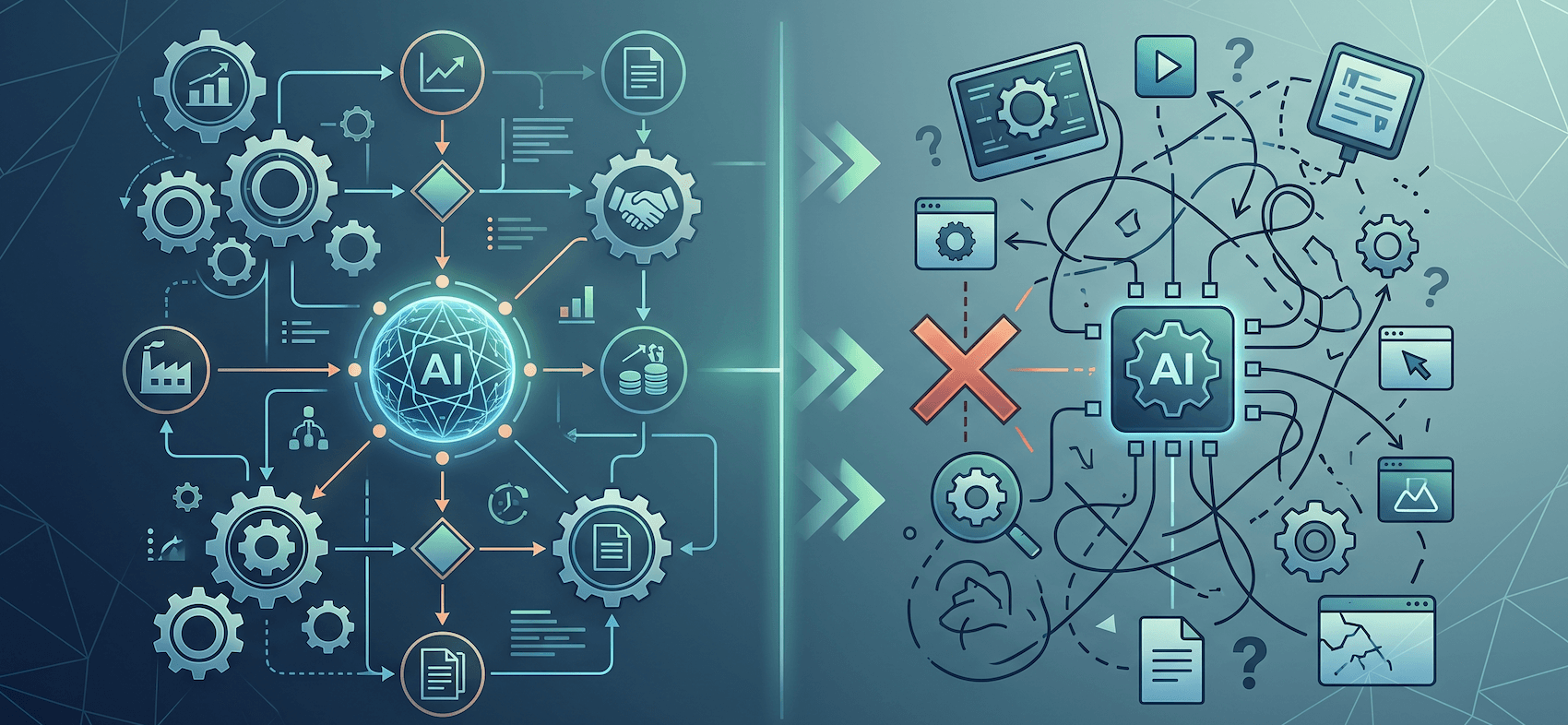
Most companies buy an AI tool first and try to fit it into their business afterward. That order rarely works. The companies getting real value from AI start by mapping how work actually moves through their organization, then choose or build the technology that fits that map. Skip that step, and you end up paying for a tool that nobody trusts enough to use.
The Tool First Trap: Buying AI Before Fixing Workflow Architecture
It’s an easy trap to fall into. A leadership team hears about a new AI product, signs up for a demo, and rolls it out to the team within weeks. The tool looks impressive in a sales pitch because it’s been tested against a clean, simplified version of a business problem. Your business isn’t clean or simplified. It has legacy systems, inconsistent data entry habits, and workflows that live in three different people’s heads.
When the tool meets that reality, it either produces unreliable output or requires so much manual correction that it becomes another task on someone’s plate instead of a time saver. The technology wasn’t the problem. The sequence was.
3 Signs Your AI Investment Is Failing
A few patterns show up again and again when we talk to companies that are frustrated with their AI spend:
- Adoption stalls after the first month. Employees quietly go back to their old process because the AI tool creates more cleanup work than it saves.
- Nobody can explain what the tool actually does. If leadership can’t describe the specific business logic the AI is executing, the tool is running on guesswork rather than a defined process.
- The output needs constant human correction. Occasional review is healthy. Constant correction means the tool was never mapped to your real data and workflow in the first place.
If any of these sound familiar, the fix usually isn’t a different tool. It’s going back a step.
The Process First Framework: Mapping Business Logic Before Model Selection
Before we recommend any AI model or platform to a client, we ask a more basic set of questions. What does this process look like today, step by step? Where does the data live, and how clean is it? Which parts of this process require human judgment, and which parts are just repetitive rules that a computer could apply consistently?
That audit produces a map of the workflow as it actually runs, not as it’s described in a training manual. Only once that map exists does model or platform selection become a straightforward decision, because you’re now matching a known problem to a known solution instead of hoping a general purpose tool happens to fit.
Sometimes the Answer Isn’t AI at All
This comes up more than people expect: not every problem that gets labeled an “AI problem” actually is one. A business will come to us convinced they need an AI tool, when what’s really slowing them down is a process that was never automated in the first place, like a form that still gets filled out by hand, two systems that don’t share a database, or a report that takes someone half a day to assemble because nobody ever wrote a script to pull the numbers automatically.
None of that requires a language model. It requires custom software: a straightforward piece of code that does a defined task the same way, every time, without judgment or interpretation involved. Adding AI to a problem like that doesn’t make it faster. It usually makes it more expensive and less predictable, since you’re paying for a flexible, judgment based tool to do a job that only needed consistency.
Part of the process first audit we run with every client is figuring out which of these two categories a problem actually falls into. If the task involves genuine ambiguity, language, or judgment calls, AI is worth exploring. If the task just needs to happen reliably and automatically, plain custom software is usually the faster, cheaper, and more durable fix. Getting that distinction right up front is often what separates a project that pays for itself in months from one that never quite delivers what was promised.
Custom Integration vs. Off the Shelf AI Wrappers
A lot of what’s marketed as an “AI solution” is a thin interface wrapped around a general purpose model, connected to your systems through a handful of basic triggers. It can work for simple, low stakes tasks. It tends to break down once your business logic has real complexity: approval chains, conditional pricing, compliance rules, or data that needs to move between systems that were never designed to talk to each other.
Custom integration means building the connective layer between your existing software and the AI model so the two actually understand each other. An AI tool that only answers generic questions is a different product entirely from one that knows your inventory rules, your client history, and your internal terminology well enough to be trusted with real work. We’ve also found it’s more affordable than most businesses assume, especially set against the cost of a tool that never gets fully adopted.
Where This Fits Into How We Work Now
A lot of what’s written about AI right now comes from people theorizing about where things are headed. We’re in a different position: we’re using AI daily to deliver work for clients, and it’s changing how we operate in real time.
The biggest shift for us hasn’t been replacing people with AI. It’s been freeing our team from the repetitive parts of the job so they can spend more time understanding a client’s real problem, building the relationship, and staying close enough to a project to catch issues before they get expensive. We try to bring that same principle to client work: AI should make the service better, not just cheaper, and it shouldn’t be the first purchase before the process is understood.
If you want to see how this plays out in practice, we’ve written about what it looks like when AI becomes a genuine coworker rather than a bolt on tool, and where AI can support expertise without replacing it. If you’re weighing whether your own systems are ready for this, our AI integration services page walks through how we approach that first audit with clients.
FAQ
How do I know if my business is ready for AI? Readiness has less to do with your industry or size and more to do with whether your core processes are documented and your data is reasonably clean. If neither is true yet, that’s the starting point, not a reason to wait indefinitely.
Is custom AI integration more expensive than buying an off the shelf tool? The sticker price on an off the shelf subscription is usually lower up front. Once you factor in the staff hours spent working around its limitations, a properly scoped custom integration is often the more affordable option over time.
How long does an AI readiness audit take? For most mid-sized businesses, a thorough process and data audit takes a few weeks, not months. The goal is a clear map you can act on, not an open ended research project.
How do I know if I actually need AI, or just custom software?
We’ve spent 30 years building software for businesses that just want it to work, AI included. If you’re not sure whether your business needs AI, custom software, or a mix of both, that’s exactly the kind of question we like to start with. Reach out for a quote or a quick meeting, no pressure, just an honest conversation about whether we’re the right fit for what you’re trying to build.


Related Posts

When SaaS Stops Scaling: The Case for Custom Software
Most mid-market businesses hit the same wall around year five...

Why Most Companies Are Approaching AI Backwards (And How to Fix It)
Most companies buy an AI tool first and try to...

WooCommerce Caching Done Right: Speed Without Breaking the Cart
Caching is one of the simplest ways to make a...

When AI Is Your Coworker, What Happens to 40 Hours?
For decades, the standard workweek has remained surprisingly consistent. Most...